
Sources for Previous Sunnyvale Residents
The time range determines which source deserves the first look. Official deeds begin in 1850 but require an offline index route. City directory holdings are uneven. Census schedules are released on a 72-year rule. A permit can date a project without naming every household. The table keeps the previous residents trail grounded in the source’s real span.
| Source | Years it covers | Where held | What it shows |
|---|---|---|---|
| Recorder deeds and index | 1850 to present | 1850 to 1980 Digital Reel; 1981 forward workstations | Grantors, grantees, legal description, recording trail |
| Assessor web result | Current roll and transfer history shown | Free Santa Clara property search | APN, latest transfer number, values, exemptions, jurisdictions |
| Regional city directories | 1909 to 1912, 1914, 1917 to 1920, 1922 to 1937; later Sunnyvale volumes | SJPL California Room and library collections | Names, streets, occupations, household clues |
| Reverse directories | Haines and Pacific Bell from mid-1960s; gaps | SJPL California Room | Historical occupants in street-number order |
| Census schedules | Through 1950 public as of 2026 | NARA and genealogy access | Occupants and relationships at census date |
| Newspapers and obituaries | Sunnyvale Standard from 1908; later regional runs | Library and newspaper archives | Moves, deaths, family, civic or business events |
| Permits and maps | Portal coverage varies; historical map years vary | Sunnyvale E-OneStop, GIS, libraries | Construction chronology and parcel context |
The previous residents question is strongest when one address stays constant through every source, even when the street label or city name changes.
Begin a Sunnyvale Previous Residents Trail
Start with the physical address in Santa Clara County Real Property Search. The form returns an APN and a latest title-transfer document number, along with transfer date, assessed values, exemptions, and tax-rate jurisdictions. The free web result omits the owner name and mailing address, so it is a property key rather than a current residents directory.
Copy the document number exactly. The Clerk-Recorder can use it at a public workstation, while the Assessor result keeps the APN available for a parcel check. The deed may name a buyer, seller, return address, legal description, and prior document reference. Those details start the previous residents backward search.
Do not read a homeowner exemption as proof that every person at the property lives there. It only reflects an eligible claim tied to the dwelling under the assessment record.
Search Sunnyvale Deed Records for Sellers
A chain of title is the linked record of property interests over time. In a Sunnyvale deed search, the current grantee or buyer points to the prior grantor or seller. Search that seller as a grantee in an earlier period, then confirm the same parcel with legal description, APN, and recording date. Repeat until the source or address history reaches its useful limit.
- Run the address search and record APN plus latest transfer document.
- Visit 110 W. Tasman Drive and use the document number at the public workstation for 1981 forward, or ask for Digital Reel guidance for 1850 through 1980.
- Read the deed image for grantor, grantee, recording date, legal description, return address, and prior references.
- Search the seller as a prior grantee and compare the legal description before linking the next transfer.
- Keep a dated chain with the document number, party role, and reason each deed belongs to the parcel.
- Grantor
- The party transferring an interest in the recorded instrument.
- Grantee
- The party receiving the interest.
- Chain of title
- The linked sequence of transfers tied to one parcel.
- Legal description
- Deed language that identifies the land apart from its postal street label.
The Recorder index uses document number, date, class, APN, grantor, grantee, or combined party searches. It does not use a street address as a complete search key.
The Sunnyvale Records Handoff
Santa Clara County’s records story has a clear dividing line. Official records date to 1850. Digital Reel covers 1850 through 1980, while public computer workstations cover 1981 forward. The online official-record index was removed on November 5, 2018. That is why a previous residents search can begin online but cannot finish as a remote deed-name lookup.
The Clerk-Recorder office at 110 W. Tasman Drive is open Monday through Friday from 8 a.m. to 4:30 p.m. Busy sessions may be limited to one hour. For mail copies, supply a recorder serial or instrument number, or book and page. An address alone is not enough.
Research note. Arrive with the APN, document number, and a written party name. The offline handoff is part of the County’s current access design.
Sunnyvale Address Records and Legal Descriptions
Postal and street labels can change while a parcel’s legal description persists. Sunnyvale research does not verify a citywide street-renumbering event or year, so a gap should not be explained with an invented renumbering story. Compare the APN, lot and block or subdivision language, plat, city-limit layer, and directory publication year.
Place names can drift too. Murphy Station, Encinal, and Sunnyvale all matter in older records. Crossman’s 1898 Encinal development and the 1901 post-office name help explain why a family may appear under a different place label before incorporation in 1912. The parcel key and legal description are better bridges than a modern postal city.
Sunnyvale Reverse Directories for Past Residents
Deeds show title parties. Reverse directories show what a publisher placed at an address in a given year. SJPL reports Haines and Pacific Bell volumes from the mid-1960s, while a verified R.L. Polk sample shows 1964 and 1968 South Murphy Avenue entries. Those entries mix businesses, apartments, societies, abbreviated names, vacancy marks, and “Street continued.”
Pair a reverse volume with its alphabetical companion. Check the same street number in the next available year and one earlier year. If an entry disappears, consider a missing volume, a publisher omission, a changed boundary, a changed number, a vacancy, or no response. The absence is not proof that a former resident never lived there.
The Sunnyvale directory book explains the collection years and reading keys; the previous residents search uses those volumes only for the backward trail.
Sunnyvale Past Residents and the 1950 Census
As of 2026, 1950 is the latest public population census under the National Archives 72-year release rule. Directory years can bracket a move, while a census schedule can show occupants and relationships on its enumeration date. They are not the same kind of record. A directory may be annual and city-focused; a census is a federal snapshot with its own geography and transcription limits.
- Choose a directory year close to 1940 or 1950 and copy the exact street and name form.
- Search the released census for the household, allowing for spelling, initials, and place-name changes.
- Compare ages, relationships, occupation, and address context without assuming every directory line is a household member.
- Use a deed, vital index, newspaper, or probate file to test the next move or a death event.
A census match can support a former household story. It does not prove title or current residence.
Date Sunnyvale Property with Records
Sunnyvale E-OneStop provides permit and plan-history search, document upload, review comments, inspections, and payment functions. A project file can contain an address, applicant or agent, contractor, property owner, work description, permit type, and related planning or Neighborhood Preservation case number where public. Those fields can date construction or a change in use.
GIS adds parcel polygons, APNs, land-use and district layers. Sanborn and other historical maps can show a footprint, use, or street context. Neither a permit nor a map is a complete previous residents list. Use the APN and legal description to keep a building chronology tied to the same land.
Sunnyvale Probate Records and Past Residents
Obituaries and probate can close a past household trail without turning a historical clue into a current-address claim. The Sunnyvale newspaper trail begins in 1908, and local collections extend through later regional titles. A public probate case may include petitions, wills, letters, notices, inventory and appraisal, or final distribution, subject to access rules. Those records can name a decedent, personal representative, counsel, and notice recipient.
Match the probate name to the deed chain, legal description, directory address, or vital index. A death notice can explain why a directory entry ends. A probate file can show a legal role. Neither should be stretched beyond its date and scope.
The California State Archives catalog can add a state-level collection lead when a local trail reaches an institutional record.
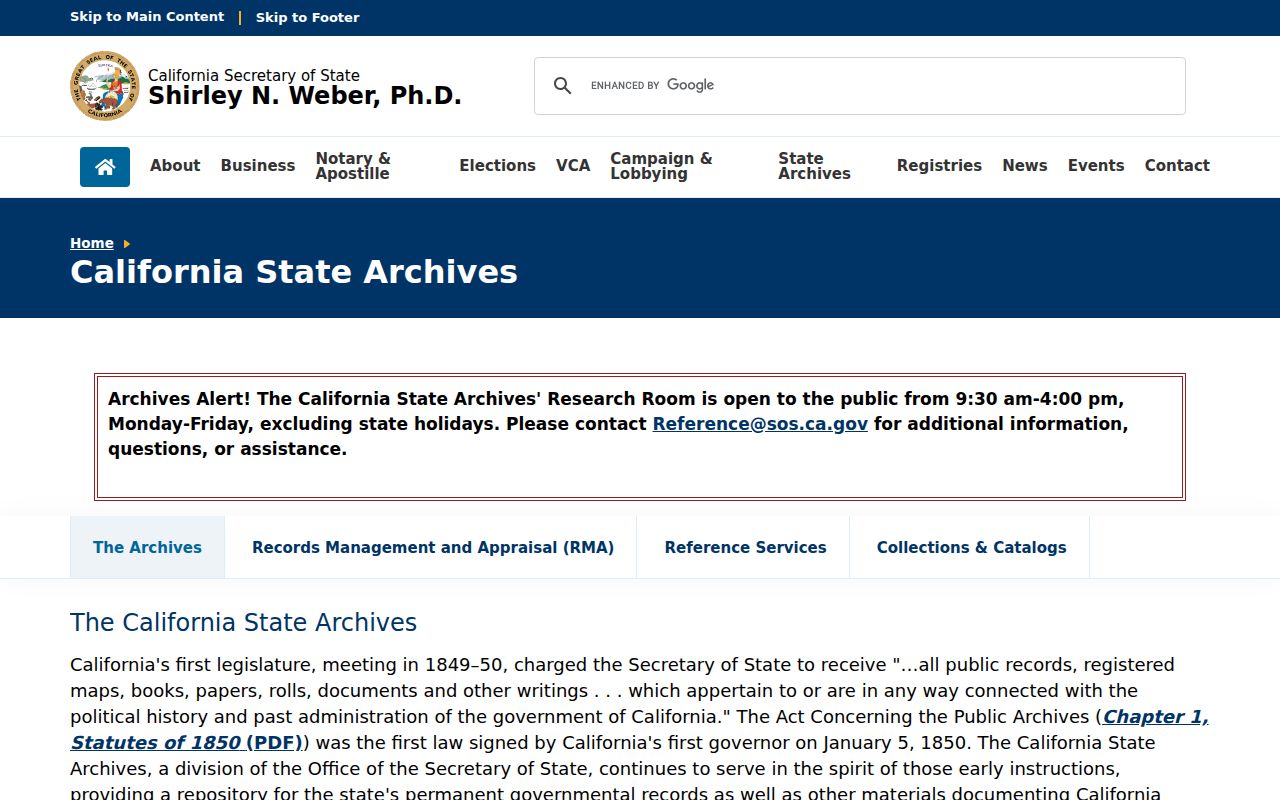
The archive image belongs to the historical handoff: it may point to a collection, but the exact series and access rule still need confirmation.
Past Households: Sunnyvale Records and Limits
Previous residents research is a house-history project. It can help reconnect relatives, understand a family’s move, trace an heir, or document a property’s changing use. It should not be used to follow, threaten, harass, or expose a protected person. California Safe at Home, sealed adoption files, protected voter data, and confidential court records can leave deliberate gaps.
Lawful use. Use previous residents records for personal history, genealogy, estate work, and civic research. Verify every important lead with the custodian and stop when the lawful access boundary ends.
For a current parcel and whole-street chain, use the Sunnyvale street directory. For a person rather than a house, use the resident lookup. The best result is a dated, sourced sequence with clear gaps, not a confident story built from one old line.