
How Sunnyvale Residents Are Found
Sunnyvale resident research works best as a chain of small checks. A known address points first to the Santa Clara County Assessor’s property search. The result gives an APN, or assessor’s parcel number, and a recent transfer document number, but the free web result leaves out the assessee name. That number leads to the Clerk-Recorder, where a deed can identify grantors and grantees. A person’s own registration can be checked through My Voter Status. Past households call for the Sunnyvale Public Library’s city directories, reverse directories, newspapers, and yearbooks.
A name alone is a weak key in a city with many households and changing names. Match a name with a date, place, APN, case number, license number, or business entity number. A record can show a title party, a permit applicant, a voter’s own status, or a historical listing without proving that every person at an address lived there. The Sunnyvale residents directory is strongest when two independent records point to the same person or property.
- Write down the exact name, address, year, or parcel clue, including middle initials and alternate spellings already known.
- Use the Assessor or city GIS to anchor an address to its APN and jurisdiction.
- Carry the latest transfer document number to the Clerk-Recorder rather than expecting a remote name or street search.
- Use the court, voter, vital, license, business, or historical source that fits the question.
- Keep the source date and the negative results, then ask the custodian about a defined record that is not online.
That order saves time. It also prevents a property clue from being mistaken for a complete resident list.
Sunnyvale’s Records Offices
Sunnyvale records sit across city, county, and state desks. City Hall handles local administrative files, permits, council material, police records, and focused California Public Records Act requests. Santa Clara County keeps the deed and map index, property assessment, vital copies, elections files, and most trial-court records in San Jose. State portals fill gaps for licenses, business filings, voter self-checks, custody records, and unclaimed property.
Each office answers a different question. The Assessor ties a situs, or property location, to an APN and transfer reference. The Recorder supplies the document image and the parties named in it. The Registrar of Voters does not expose a public street roster through its self-service tool. The Clerk-Recorder, Superior Court, and library can explain access routes without certifying that two similarly named people are the same person.
Santa Clara County Clerk-Recorder
110 W. Tasman Drive
San Jose, California
408-299-5688
Santa Clara County Assessor
130 W. Tasman Drive
San Jose, California
408-299-5500
Santa Clara Registrar of Voters
1555 Berger Drive, Building 2
San Jose, California
408-299-VOTE
Hours and service rules can change. Confirm the route with the named custodian before making a trip, especially when a copy, appointment, or public-terminal session is needed.
The Sunnyvale Assessor Result Is a Bridge
The Santa Clara County Real Property Search is useful because it gives a starting key without pretending to be a residents directory. It accepts a simple situs address, an advanced address, or an APN. The terms checkbox must be accepted. A result can show the APN, the latest transfer document number and type, transfer date, assessed land and improvement values, exemptions, and tax-rate jurisdictions. The public web result intentionally omits the assessee name and mailing address.
| Search field | Type and rule |
|---|---|
| Property address | Text or autocomplete; use the situs address, not a mailing address. |
| Terms checkbox | Required before the search can run. |
| Street number and name | Advanced address fields; street type, direction, and unit refine the match. |
| City | Required in advanced mode; select Sunnyvale for a Sunnyvale situs. |
| APN number | Search with or without dashes, such as 12345678 or 123-45-678. |
| Search | Runs the chosen address or APN mode after the terms step. |
The result is a bridge because the latest transfer number can be taken to the Recorder’s office-only deed research system. Do not read the APN as a person name, and do not treat a homeowner exemption as proof that every household member owns or occupies the parcel.
For a visual view, the Assessor search interface shows the address and APN workflow. The image below reflects the public property-search surface; the omitted owner field is part of the access limit, not a missing search step.
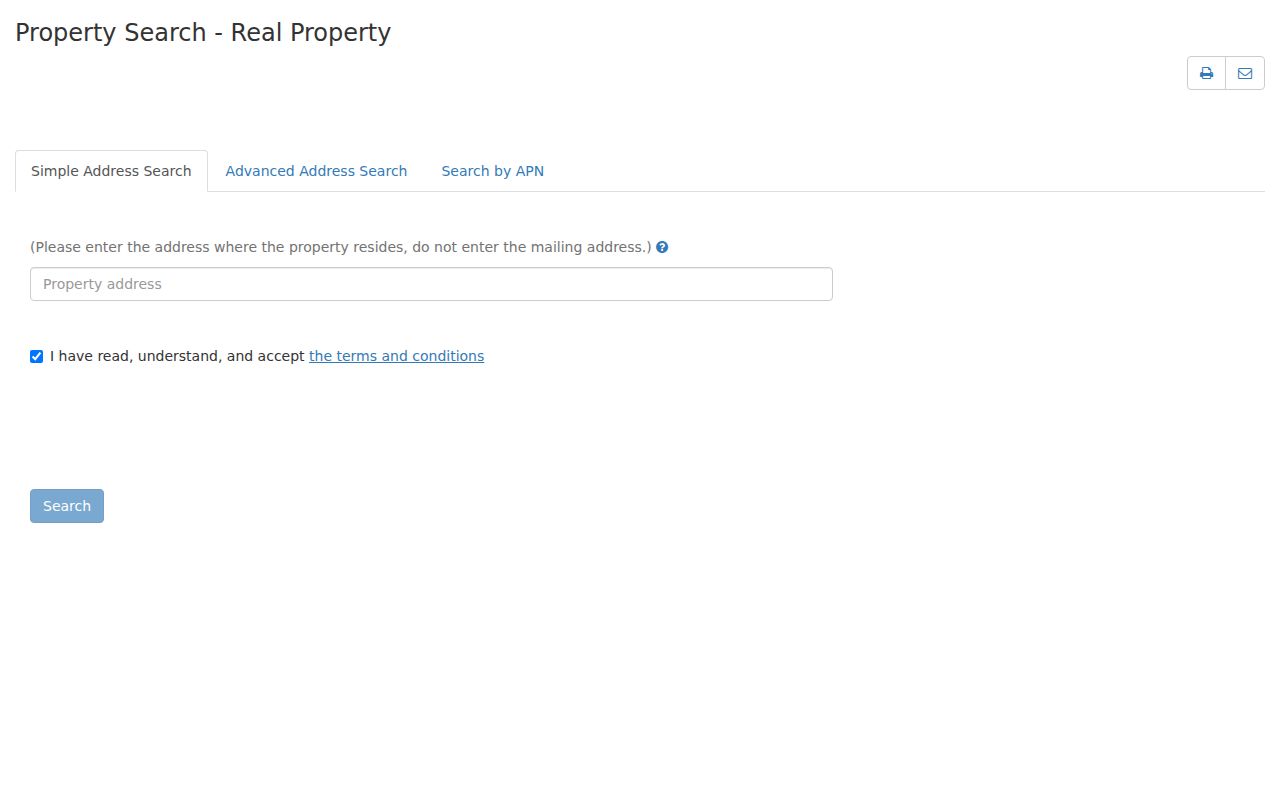
Use the APN and transfer number as stable research keys, then verify names in the underlying custodian record.
Why Sunnyvale Deeds Leave the Web
Santa Clara County removed its online official-record index on November 5, 2018. The deeds did not vanish. Records begin in 1850, with 1850 through 1980 on Digital Reel and 1981 forward on public workstations at 110 W. Tasman Drive. The Recorder does not index property by street address, so an address alone is not enough for a copy request.
The local handoff is simple but unusual for a digital city: search the property by situs in the Assessor tool, copy the APN and latest document number, then use that key at the Recorder. A deed image may show buyer and seller, recording date, legal description, and a return address. Search the seller as an earlier grantee to move backward. Older work may need a year with a grantor, grantee, book, page, or document number.
Offline handoff. A remote miss in the deed index is expected. Keep the APN and instrument number, then ask the Clerk-Recorder for the correct workstation or Digital Reel route.
The Recorder office is open Monday through Friday from 8 a.m. to 4:30 p.m. Busy workstation sessions may be limited to one hour. A mail copy request needs the recorder serial or instrument number, or a book and page reference. A broad request to “find everyone” is not a substitute for a defined record search.
Current Sunnyvale Directory Sources
A current Sunnyvale residents directory is best understood as several narrow lists. None is a complete roll of every person at an address. The table separates what the source actually identifies from what a reader may only infer.
| Source | What It Can Identify | Keeper | Access |
|---|---|---|---|
| Real Property Search | APN, transfer reference, values, exemptions, tax areas | Santa Clara Assessor | Free web result; assessee name omitted |
| Official-record deed | Grantor, grantee, legal description, return information | County Clerk-Recorder | In-person index and image access |
| My Voter Status | A matching voter’s own registration and election information | California Secretary of State | Identity-matched self lookup |
| City permit or plan history | Project address and public applicant or contractor fields | Sunnyvale E-OneStop | Online search, kiosks, counter, or request |
| License or business filing | Professional, entity, agent, or practice connection | California agencies | Free indexes with board-specific limits |
For a one-person question, use the Sunnyvale resident lookup workflow. For a whole street, the address-keyed Sunnyvale street directory keeps the parcel and deed chain in one place. The current directory idea is useful only when the source, date, and access boundary stay attached to the result.
What California Voter Status Confirms
My Voter Status is a private self-check, not a public resident search. It asks for a first name, last name, California driver license or ID, the last four digits of a Social Security number, and birthdate. A matching voter receives registration and election information. The tool does not let a visitor enter a street and obtain a block roster.
The form uses four identity checks: first and last name, California driver license or ID, the last four Social Security digits, and birthdate. Those fields explain why the result belongs to the matching voter and cannot be repurposed as an open block search.
The regulated voter file is different. Approved-purpose access can include registration date, residence and mailing information, precinct, party preference, status, language, vote-by-mail status, and participation by election and method. Addresses, contact data, identifying data, and signatures are protected except through the authorized process. Ballot choices never appear in participation history.
California Elections Code sections 2188, 2194, and 18109 matter here. Statewide file access can cost $100, while a specific voter request is $30, up to ten and $100 per application, with stated processing of 7 to 14 business days. Use the official My Voter Status lookup for a personal check, not a street list.
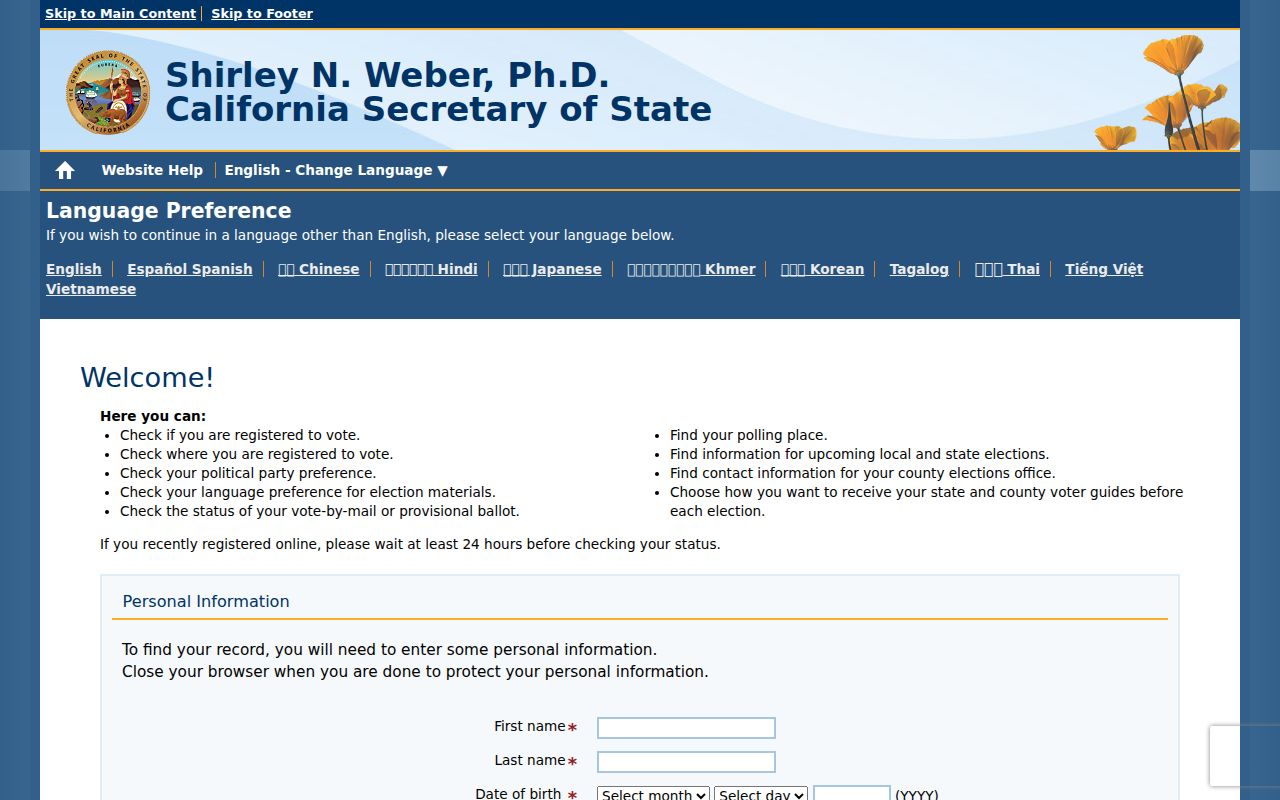
The identity fields shown in the voter-status form explain why the result is personal and cannot be repurposed as an open block directory.
Sunnyvale Court Records Need Name Checks
Sunnyvale matters go through the Santa Clara Superior Court. Its Case Information Portal offers Case Number, Party, Business, and Filing Date search modes. Party search uses first and last name. Filing Date search uses a date range of no more than five days and may require a case type. The portal can cover civil, small claims, probate, some family, traffic, local ordinance, and criminal indexes, but the Court does not publish a first-online year for every case type.
Case Number Search accepts five to sixteen alphanumeric characters. Party Search uses first and last name. Business Search takes a business name. Filing Date Search uses Date From and Date To in MM/DD/YYYY format, limits the span to five days, and can require a generated case type. Use the narrowest mode available.
Open results can include case number and title, filing and disposition dates, status, type, related cases, party and counsel details, motions, orders, rulings, and scheduled events. Sealed, juvenile, adoption, and protected items stay outside public access. A web miss is not proof that no file exists; courthouse terminals and the clerk’s records page can be the next route.
The Santa Clara Case Information Portal image below shows the court-search surface. It is a case index, not a complete copy of every filing.
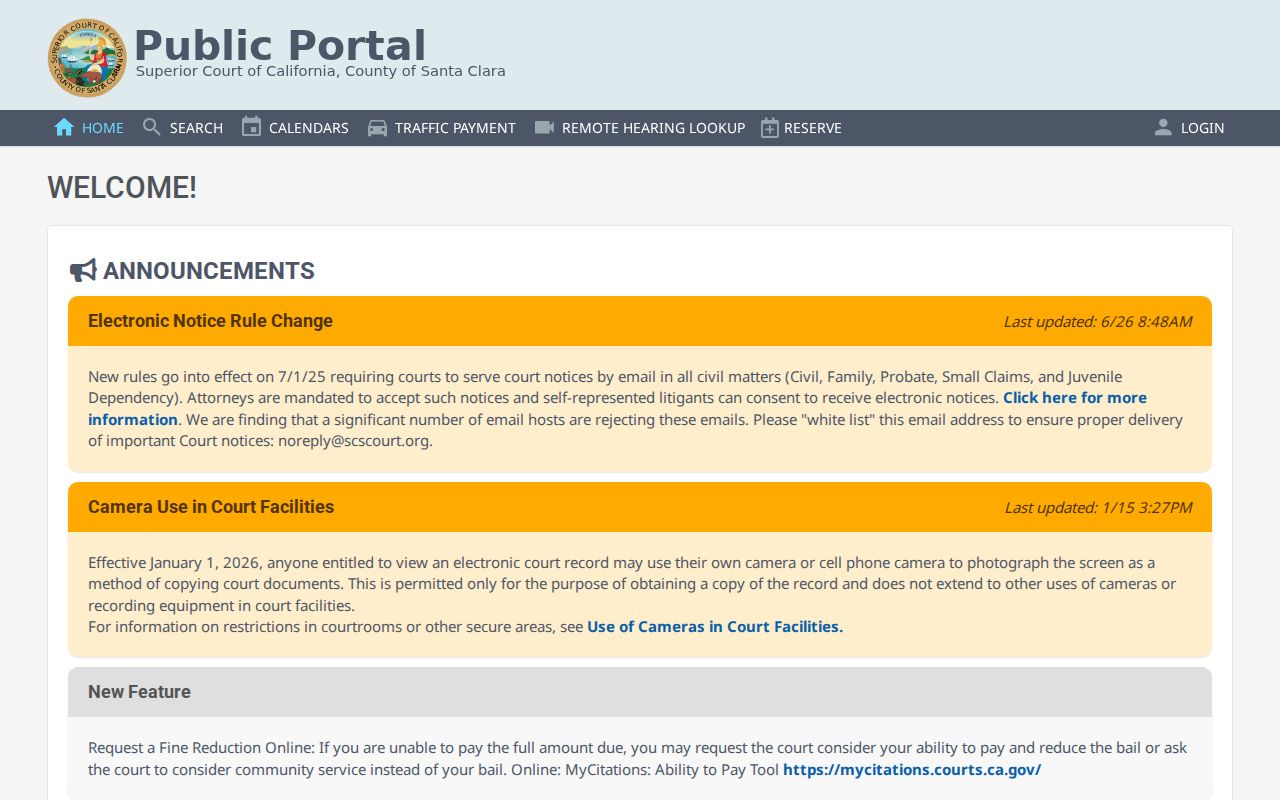
Match a court party with a date, case type, or property clue before treating the entry as the right person.
Sunnyvale Business and License Trails
A professional license or business filing can verify a public work or entity connection without claiming that the listed address is a home. California Department of Consumer Affairs search fields include board or bureau, license type, license number, business name, first name, last name, and registry number. State Bar, contractor, medical, real-estate, and alcohol-license portals have their own fields and public-action limits.
Secretary of State bizfile searches by entity name or file number and can filter by entity type, status, initial filing date, and publicly traded disclosure. Detail pages may show formation date, status, jurisdiction, street and mailing addresses, agent for service, Statement of Information due date, and filed PDFs. The index does not promise beneficial ownership, phone, email, subsidiaries, or every associated business.
| Official record path | Compiled-data category |
|---|---|
| Named custodian, stated field set, date, and source rules | May merge public and commercial data from several dates |
| License, entity, FBN, or filing number can narrow a namesake | May conflate people with similar names or stale addresses |
| Copy, correction, or verification route leads back to the keeper | May charge recurring fees and is not a substitute for a certified record |
Start with the California license search when a board or license clue exists.
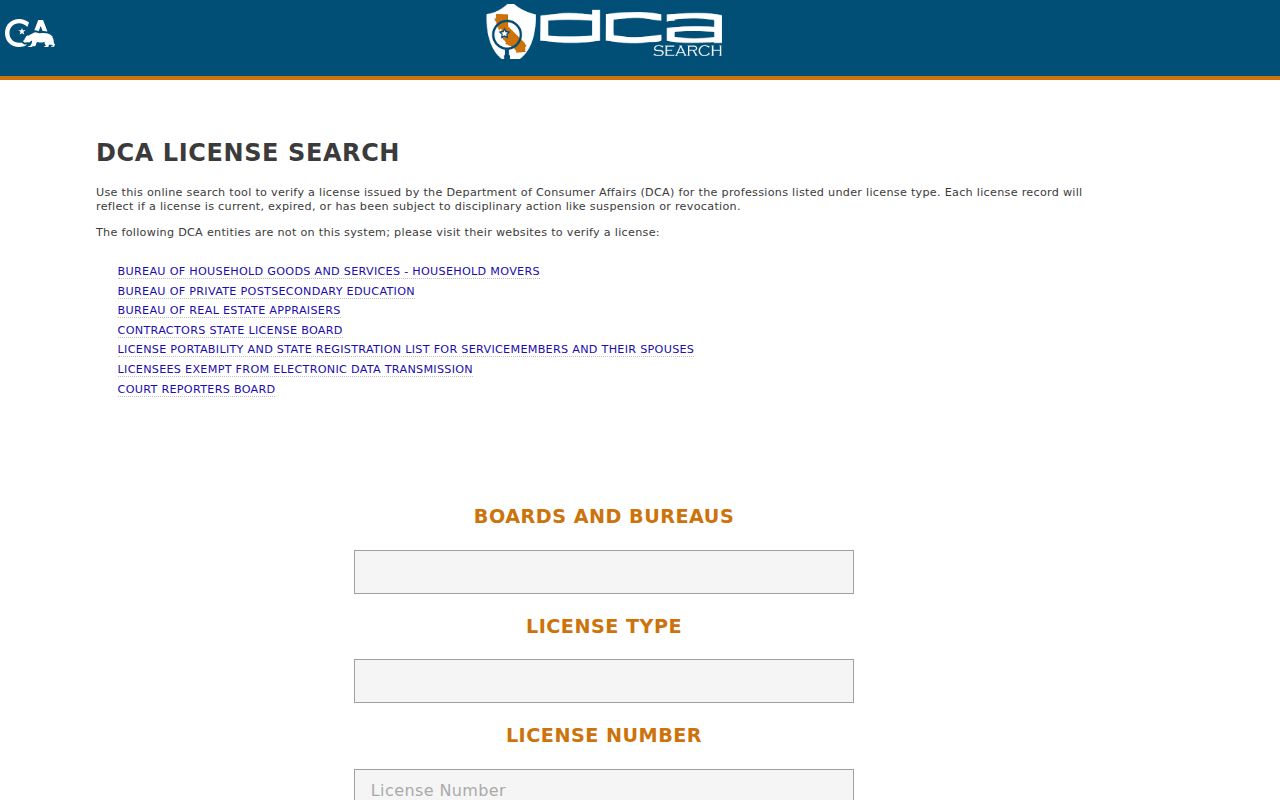
The license search can narrow a namesake by board and number, which is more reliable than a name alone.
For an entity lead, use California bizfile and keep the entity number with the result.
A business filing identifies a filing relationship. It does not turn a business address into proof of personal residency.
Sunnyvale’s Four ZIP Geography
Sunnyvale’s 2025 reporting treats 94085, 94086, 94087, and 94089 as the four primary ZIP codes, arranged broadly from north to south. ZIP 94088 is associated with Sunnyvale processing but is treated as a nonstandard or unique route rather than a fifth residential zone. USPS routing, postal city labels, and municipal limits are different layers.
City Hall uses 456 W. Olive Avenue with 94086, while the main postal facility at 209 E. Java Drive serves the Sunnyvale system. A 2012 USPS move changed notice and hold routing among facilities, including Encinal Station for specified 94085 pickups. Use the USPS address lookup for a single ZIP, then use city GIS or an APN to confirm jurisdiction. The Sunnyvale ZIP code directory keeps those distinctions together.
Historical Sunnyvale Directory Shelf
Sunnyvale city directory research starts with the California Room and Santa Clara County Library resources. SJPL reports standalone Sunnyvale volumes around 1964 to 1968, with verified catalog copies for 1964 and 1966 and a need to confirm 1968 before a visit. Broader San Jose and Santa Clara volumes cover earlier years, including 1909 to 1912, 1914, 1917 to 1920, and 1922 to 1937. The grid labels the town as “Sunnyvale, formerly Encinal,” so old place names belong in the search.
Reverse and criss-cross directories add address order. Newspapers run from the 1908 Sunnyvale Standard through later regional collections, and the library holds yearbooks, images, oral histories, and genealogy databases. A directory entry can suggest an occupant, spouse, occupation, or property mark for one publication year. It cannot prove a current home. The full collections and reading method appear in the Sunnyvale city directory book.
Heirs, Probate, and Sunnyvale Property
For an heir question, probate and recorded property can create a lawful, documented trail. Search the Superior Court by party, identify a probate case, and ask for public petitions, wills, letters, inventory and appraisal, notices, or final distribution when the access rule allows. Then compare names and legal descriptions with recorded deeds. A decedent’s property file may connect a petitioner or personal representative to a parcel, but the court file and deed each have their own limits.
The useful match is not a single name. It is a name plus a case type, date, parcel, notice, or recorded document. Keep sealed adoption and confidential court material out of the search, and do not ask a public office to create a new residents directory from scattered records.
Sunnyvale Record Terms to Know
Small terms change the meaning of a search. These distinctions keep a Sunnyvale residents directory inquiry tied to the record that can actually answer it.
- APN
- An assessor’s parcel number, used to connect a property result to maps and deed research.
- Situs address
- The physical location of a parcel. It is not automatically the owner’s mailing address.
- Grantor and grantee
- The grantor transfers an interest; the grantee receives it in a deed or related instrument.
- Index
- A catalog row that points to a record. It is not the same as the document image.
- Criss-cross directory
- A historical reverse directory arranged by address or street, often used beside an alphabetical volume.
Privacy Around Sunnyvale People Records
California records are not a blank check for personal data. My Voter Status protects the self-check behind identity fields. Safe at Home can provide a designated mailing address and confidential mail forwarding for eligible survivors and certain public-facing workers. Government Code protections restrict online publication of some officials’ home addresses. DMV, utility, delivery, and account records should not be treated as a public directory.
California’s CCPA and CPRA rights can help a resident ask a covered business to know, delete, correct, or stop sale or sharing of covered data. The Delete Request and Opt-out Platform, known as DROP, gives a registered resident one centralized request across registered data brokers. Those rights do not erase a recorded deed or a court file held by a public custodian.
Lawful personal use. Use Sunnyvale records for family history, civic research, reconnecting, property curiosity, or personal safety awareness. Never use a record trail to stalk, threaten, harass, impersonate, or harm another person.
California stalking law is Penal Code section 646.9, and repeated harassing electronic communication can implicate section 653m. Verify a lead with the agency that holds the record before acting on it.
For a safety lead, the county custody finder, CDCR locator, and Megan’s Law site have different coverage and exclusion rules. A no-result can mean transfer, release, spelling variation, restricted disclosure, or a gap in the source. The Santa Clara inmate finder image below is a portal reference, not a promise of a complete list.
Use custody and registry sources only for the lawful personal-safety purpose they permit, and verify current information with the custodian.
Sunnyvale’s Record-Keeping Story
Sunnyvale adopted its name in 1901 and incorporated on December 24, 1912. The town grew from orchard subdivisions into industrial and technology districts, so the record trail changes by era. Murphy Station, Encinal, and Sunnyvale can all matter in an old directory search. The 1900 directory reportedly listed only one carpenter, Thomas Spencer, a reminder that early volumes may be sparse rather than wrong.
That history also explains why APNs, legal descriptions, city-limit layers, and directory publication notes matter. A postal label is not a time machine. The same address clue should be tested against the volume year, the city boundary at publication, and the deed or map record that carried the parcel forward.
Verify a Sunnyvale Directory Lead
Start with the narrowest official record that matches the question. A property clue belongs with the Assessor and Recorder. A court clue belongs with the Superior Court. A personal voter question belongs with My Voter Status. A former household belongs with directories, newspapers, census schedules through 1950, and then deeds or vital indexes. A business clue belongs with an entity or license number.
Compare at least two records that did not copy from one another. Note the date, the source, the search fields, and the reason a result may be absent. If a result affects a person, ask the custodian to confirm the record rather than treating a Sunnyvale residents directory lead as final proof. That habit is the best protection against namesakes, stale listings, and false certainty.